

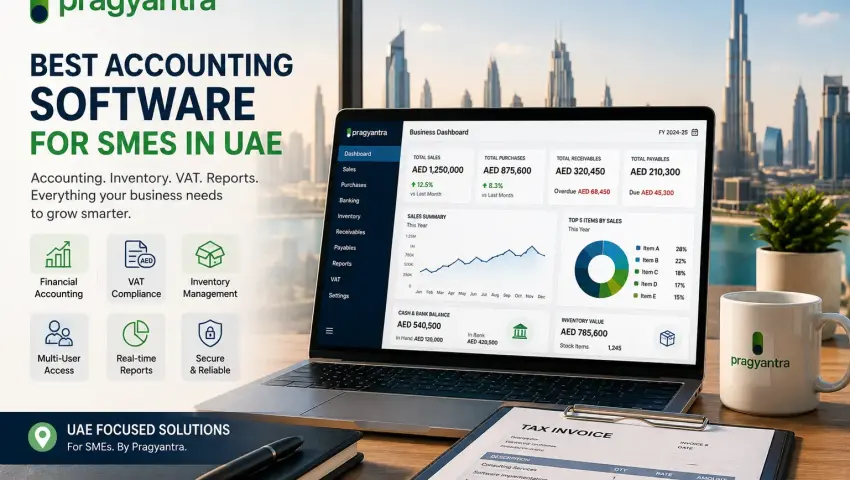
Best Accounting Software for SMEs in UAE
 By Pragyantra
- Tally Solutions
- Aug 24, 2026
- 13 minutes read
- 138 Views
Looking for the best accounting software for SMEs in UAE? Compare TallyPrime, Zoho Books, QuickBooks, Odoo and other options based on , inventory, reporting, integrations and business needs.
Best Accounting Software for SMEs in UAE: A Practical Guide for Businesses
- Accounting Software for SMEs in UAE
- Best Accounting Software UAE
- Accounting Software Dubai
- UAE Accounting Software
- Business Accounting Software UAE
- SME Accounting Software UAE
- Accounting Software UAE
- Cloud Accounting Software UAE
- TallyPrime UAE
- Zoho Books UAE
- QuickBooks UAE
- Odoo Accounting UAE
Best Accounting Software for SMEs in UAE
Choosing accounting software is not as simple as picking the software with the most features.
For a small business in the UAE, the right accounting system needs to fit the way the business actually operates.
A service company may mainly need invoicing, expenses, banking, reporting, and financial statements. A trading company may need strong inventory management, multiple warehouses, purchase and sales workflows, and multi-currency support. A growing business may also need CRM, eCommerce, payment gateway, or ERP integrations.
And then there is the UAE tax and compliance environment to consider.
So, what is the best accounting software for SMEs in UAE?
The honest answer is:
There is no single accounting software that is best for every UAE business.
The better question is:
Which accounting software fits your business size, industry, workflow, reporting requirements, and future growth?
In this guide, we compare some of the leading options used by UAE businesses and explain what to look for before making a decision.
What Should UAE SMEs Look for in Accounting Software?
Before comparing software names, it is worth understanding the features that actually matter.
A good accounting system for a UAE SME should ideally support:
- UAE workflows
- Tax-compliant invoicing
- Accounts receivable
- Accounts payable
- Expense management
- Bank reconciliation
- Financial reporting
- Inventory management, where required
- Multi-currency transactions
- User access controls
- Data backup and security
- Business integrations
- Automation
- Mobile or remote access, where required
- Future eInvoicing requirements
The importance of each feature depends on the business.
For example, a consulting company with ten employees may not need advanced warehouse management. A wholesale distributor with several warehouses probably does.
Best Accounting Software Options for UAE SMEs
Some of the accounting and business management platforms that UAE businesses commonly consider include:
- TallyPrime
- Zoho Books
- QuickBooks
- Odoo
- Xero
- Wafeq
- SAP Business One for businesses with more extensive ERP requirements
The right choice depends on the business model rather than simply the software's popularity.
1. TallyPrime
Best for: Trading, distribution, retail, inventory-focused businesses and businesses looking for customization
TallyPrime is a well-known accounting and business management solution with a strong presence among businesses that need accounting combined with inventory and operational workflows.
For UAE businesses, TallyPrime supports UAE-specific capabilities, invoicing, accounting, inventory, banking, reporting, and multi-currency requirements. Its UAE/MENA offering is specifically positioned for regional businesses.
Key strengths
- Accounting
- Sales and purchase management
- Inventory management
- -related workflows
- Multi-currency
- Business reporting
- Invoice customization
- Arabic and English invoicing capabilities
- TallyPrime customization
- TDL development
- API and third-party integrations
TallyPrime can be particularly interesting for businesses that have more complex inventory or trading requirements and want to customize the system around their existing processes.
Best suited for
- Trading companies
- Wholesale businesses
- Distributors
- Retail businesses
- Manufacturing businesses
- Inventory-heavy SMEs
- Businesses already familiar with Tally
2. Zoho Books
Best for: Cloud-based accounting and businesses already using the Zoho ecosystem
Zoho Books is a cloud accounting platform with a dedicated UAE edition.
It includes accounting, invoicing, bills, expenses, banking, inventory, reporting, online payments, automation, features, and corporate tax-related accounting capabilities.
Zoho Books also supports UAE workflows and provides reporting and filing functionality connected with EmaraTax.
Key strengths
- Cloud accounting
- Online invoicing
- Expense management
- Banking
- Inventory
- management
- Automated payment reminders
- Multi-currency
- Mobile accounting
- Zoho ecosystem integrations
- Business automation
Best suited for
- Service businesses
- Startups
- Small businesses
- Professional firms
- Businesses already using Zoho CRM
- Businesses wanting cloud-first accounting
Zoho Books can become particularly useful when accounting needs to connect with other Zoho applications such as CRM, Projects, Inventory, or other business tools.
3. QuickBooks
Best for: Small businesses and teams familiar with the QuickBooks ecosystem
QuickBooks is another widely recognized accounting platform used by small and medium-sized businesses.
Its strengths generally include accounting, invoicing, expenses, reporting, and integrations.
For a UAE business considering QuickBooks, it is important to check the current UAE/MENA product availability and specific localization features before implementation rather than assuming that features available in another country are identical.
This is especially important when evaluating:
- workflows
- Tax reporting
- Banking integrations
- Multi-currency
- Local compliance requirements
- eInvoicing readiness
Best suited for
- Small businesses
- Service businesses
- Businesses already familiar with QuickBooks
- Companies working with accountants familiar with the platform
4. Odoo
Best for: Businesses looking for a broader ERP system
Odoo is different from a traditional accounting-only solution.
It provides a wider business management environment that can include:
- Accounting
- CRM
- Sales
- Purchase
- Inventory
- Manufacturing
- HR
- Projects
- Website
- eCommerce
For a growing UAE business that wants multiple departments operating within one broader ERP environment, Odoo can be worth considering.
Its UAE localization supports -related accounting and reporting workflows.
Best suited for
- Growing SMEs
- Manufacturing businesses
- Distribution companies
- Businesses with multiple departments
- Companies looking for ERP rather than accounting alone
The main consideration with Odoo is implementation. A powerful ERP still needs to be configured properly around the company's actual processes.
5. Xero
Best for: Growing businesses that prioritize cloud accounting, collaboration and integrations
Xero is a cloud-based accounting platform often considered by businesses that want online accounting, financial reporting, reconciliation, and integrations.
For UAE businesses, its suitability should be evaluated based on the exact tax, reporting, banking, and localization requirements of the company.
Best suited for
- Service businesses
- International businesses
- Businesses working with external accountants
- Companies that prioritize cloud collaboration
6. Wafeq
Best for: UAE and GCC-focused businesses
Wafeq is a regional accounting and finance platform designed around businesses operating in the Gulf region.
Businesses looking for a UAE/GCC-oriented solution may consider it when comparing accounting platforms.
Its regional focus can be particularly relevant for companies looking for localized workflows rather than adapting a global accounting system to their specific market.
7. SAP Business One
Best for: Growing and mid-sized businesses with broader ERP requirements
SAP Business One is designed for businesses that need more than basic accounting.
It can bring together areas such as:
- Financial management
- Sales
- Purchasing
- Inventory
- Customer management
- Reporting
- Business operations
It is generally more suitable for businesses with more complex processes and larger implementation requirements.
For a small business with straightforward accounting requirements, a simpler platform may make more sense.
Accounting Software Comparison · UAE SMEs
Accounting Software Comparison ·UAE SMEs
GCC-ready · 2026
| Software | Best For | Accounting | Inventory | Cloud | Integrations | UAE Support |
|---|---|---|---|---|---|---|
| TallyPrime | Trading & inventory-focused SMEs | Strong | Available via deployment | |||
| Zoho Books | Cloud SMEs & service businesses | ✓ | ||||
| QuickBooks | Small businesses | Depends on setup | ✓ | Check current UAE config | ||
| Odoo | ERP-focused businesses | Strong | ✓ | |||
| Xero | Cloud & international businesses | Limited vs ERP | ✓ | Check UAE requirements | ||
| Wafeq | UAE / GCC businesses | Depending on setup | ✓ | Regional focus | ||
| SAP Business One | Growing / mid-market | Strong | Deployment dependent |
TallyPrime vs Zoho Books: Which Is Better for UAE SMEs?
This is one of the comparisons businesses frequently consider.
But the answer depends on the type of company.
Choose TallyPrime when:
- Inventory is important
- You run a trading or distribution business
- Your team already understands Tally
- You need extensive customization
- You need TDL development
- You want specific business workflows
- You need integration with existing systems
Choose Zoho Books when:
- You prefer cloud-first accounting
- Your business is service-oriented
- You already use Zoho applications
- You need online collaboration
- You want accounting connected with a wider SaaS ecosystem
Neither option is automatically "better".
The right choice depends on your business requirements.
Cloud Accounting vs Desktop Accounting in the UAE
Another important decision is whether your business needs a cloud-based system or a desktop-oriented accounting environment.
Cloud Accounting
Cloud platforms allow users to access accounting information through internet-connected devices.
This can be useful for:
- Remote teams
- Multi-location businesses
- Business owners who travel
- External accountants
- Distributed finance teams
Desktop-Based Accounting
Desktop-oriented systems can be attractive for businesses that prefer local control, established workflows, or specific operational requirements.
TallyPrime users can also explore cloud deployment options where remote access is required.
The decision should be based on security, access requirements, workflow, infrastructure, cost, and the type of accounting system your team already uses.
UAE and Accounting Software
should be one of the first things UAE businesses consider when evaluating accounting software.
The system should help your finance team maintain accurate records and generate the information required for reporting.
For example, software should be able to handle relevant transaction treatments and provide reports that help finance teams prepare their obligations.
Zoho Books' UAE edition provides reporting and direct filing functionality through EmaraTax.
TallyPrime's UAE capabilities include 201 workflows and EmaraTax-related reconciliation and submission functionality.
However, accounting software should support compliance. It does not replace the responsibility of the business or its tax adviser to ensure that transactions and filings are correct.
What About UAE Corporate Tax?
Corporate Tax is another reason why businesses need reliable accounting records.
The software you choose should allow you to maintain organized financial data and generate appropriate reports for your tax and accounting processes.
Rather than choosing software simply because it says "Corporate Tax Ready", businesses should check what the product actually supports and whether it fits their accountant's workflow.
The quality of the underlying accounting data remains extremely important.
UAE eInvoicing: Another Factor to Consider
The UAE is also moving toward electronic invoicing.
The Ministry of Finance's official eInvoicing programme uses structured electronic invoice data and is being implemented through a Peppol-based 4-Corner Model. The Ministry published its UAE Electronic Invoicing Guidelines in February 2026.
This means businesses evaluating new accounting software should not only ask:
"Can this software create a PDF invoice?"
They should also ask:
"How will this system support the UAE's future eInvoicing requirements?"
That makes integration capabilities increasingly important.
Don't Choose Accounting Software Only by Price
Price matters, especially for SMEs.
But choosing the cheapest accounting software may not always be the cheapest decision in the long run.
Consider the complete cost:
- Software subscription or licence
- Implementation
- Data migration
- Customization
- Integrations
- Training
- Support
- Maintenance
- Additional users
- Additional modules
A cheaper system that requires employees to manually transfer data between applications can eventually create more operational costs.
A slightly more expensive system with better automation may deliver better value.
Integration Is Becoming More Important for UAE Businesses
Modern businesses rarely use one software application.
A typical company may use:
Website + CRM + Accounting + Inventory + Payment Gateway + WhatsApp + Management Dashboard
If these systems don't communicate with each other, employees may have to enter the same information multiple times.
For example:
A customer places an order on your website.
The sales team receives it.
Someone enters the order into another system.
The finance team enters the invoice into accounting software.
Then someone sends the invoice through WhatsApp.
That is a lot of manual work.
With the right integration, these steps can potentially be connected.
Pragyantra provides Tally integration, API connectors, WhatsApp automation, payment gateway integration, and business dashboard solutions to help businesses connect their systems.
How Pragyantra Helps UAE Businesses Choose & Connect Accounting Software
Choosing software is only the first step.
The bigger challenge is making it work with your existing business processes.
Pragyantra helps businesses with:
Accounting Software Consultation
Understand your business requirements before selecting or changing software.
TallyPrime Implementation
Configure TallyPrime according to your accounting and operational requirements.
TallyPrime Customization
Build custom reports, workflows, controls, and business-specific functionality.
API Integration
Connect accounting software with CRM, ERP, eCommerce, payment gateways, and other applications.
WhatsApp Automation
Automate invoices, payment reminders, account statements, and other customer communications.
Business Dashboards
Bring accounting, sales, inventory, and other business information into centralized dashboards.
How to Choose the Best Accounting Software for Your UAE Business
Before making a decision, answer these questions:
1. What type of business do you run?
Trading, retail, manufacturing, services, eCommerce, or professional services?
2. How many transactions do you process?
Transaction volume can influence the software and infrastructure you need.
3. Do you need inventory?
If inventory is central to your business, compare stock management capabilities carefully.
4. Do you need multiple currencies?
This is particularly important for UAE companies working with international suppliers and customers.
5. Do you need Arabic and English?
Check the exact language and invoice capabilities offered by the software.
6. What other systems do you use?
Your accounting software should ideally integrate with the systems you already depend on.
7. What reports does management need?
Don't choose software based only on the accounting features. Look at management reporting too.
8. How much automation do you need?
Identify repetitive tasks that could be automated.
9. How will your business handle future eInvoicing requirements?
Make sure the vendor has a clear approach to UAE eInvoicing readiness.
10. Who will implement and support the system?
Good software can still become difficult to use if implementation and training are poor.
So, What Is the Best Accounting Software for SMEs in UAE?
There is no universal winner.
TallyPrime can be a strong option for trading, distribution, retail, and inventory-focused businesses that value customization and established accounting workflows.
Zoho Books can be a strong option for cloud-first SMEs and businesses already using the Zoho ecosystem.
Odoo is worth considering when accounting needs to sit alongside CRM, inventory, manufacturing, sales, or broader ERP operations.
QuickBooks and Xero can suit businesses looking for established cloud accounting platforms, subject to checking current UAE localization and requirements.
Wafeq can be relevant for businesses looking for a UAE/GCC-focused accounting environment.
SAP Business One is more appropriate for businesses with broader ERP requirements and larger implementation needs.
The best choice is ultimately the one that fits your business model, accounting requirements, inventory needs, compliance workflow, integrations, budget, and growth plans.
Final Thoughts
Choosing accounting software in the UAE should not be treated as simply comparing logos and monthly prices.
Your accounting system sits at the center of your financial operations.
It affects how you manage invoices, records, inventory, payments, customers, suppliers, reports, and increasingly, how your business prepares for digital invoicing requirements.
Before choosing a platform, understand your current workflow and identify where your team is losing time.
If your business already uses TallyPrime, Zoho, Odoo, QuickBooks, or another accounting platform but still depends heavily on Excel and manual data entry, you may not need to replace the system.
Integration and automation may be the better next step.
Pragyantra helps UAE businesses with accounting software implementation, customization, integration, automation, and connected business solutions.
Need help choosing or connecting accounting software for your UAE business? Talk to Pragyantra.
Frequently Asked Questions
What is the best accounting software for SMEs in UAE?
There is no single best option for every SME. TallyPrime, Zoho Books, Odoo, QuickBooks, Xero, Wafeq, and other platforms serve different business requirements. The right choice depends on your industry, transaction volume, inventory, reporting, compliance, and integration needs.
Which accounting software is best for trading businesses in UAE?
Trading businesses should prioritize inventory management, purchasing, sales, receivables, payables, multi-currency, and reporting. TallyPrime is one option worth considering for businesses with these requirements.
Is TallyPrime suitable for UAE businesses?
Yes. TallyPrime has a UAE/MENA offering with accounting, inventory, invoicing, , reporting, and other business management capabilities.
Is Zoho Books suitable for UAE SMEs?
Zoho Books has a dedicated UAE edition with accounting, invoicing, inventory, , reporting, automation, and integrations.
Can accounting software be integrated with TallyPrime?
Yes. Depending on the software and available APIs, TallyPrime can be connected with CRM, ERP, eCommerce, payment gateways, WhatsApp, and custom business applications.
Does accounting software handle UAE ?
Many leading accounting platforms provide UAE features, but businesses should verify the exact reports, filing workflow, localization, and current compliance support offered by the specific software.
What should UAE SMEs consider before buying accounting software?
Consider requirements, accounting features, inventory, multi-currency, Arabic/English support, integrations, automation, reporting, security, implementation, support, and future eInvoicing requirements.
Want to Experience Accounting Software ?
Book a free demo and explore how your business can run in a secure cloud environment with full control and safety. Contact our team today to start your free trial.
📦 Get 100+ custom tally addons now. 📞 Talk to a Cloud Expert
🏢 Pragyantra Solutions | Phone: +91 77280 57558 | Web: www.pragyantra.com

Pragyantra
Leave a comment
Your email address will not be published. Required fields are marked *