
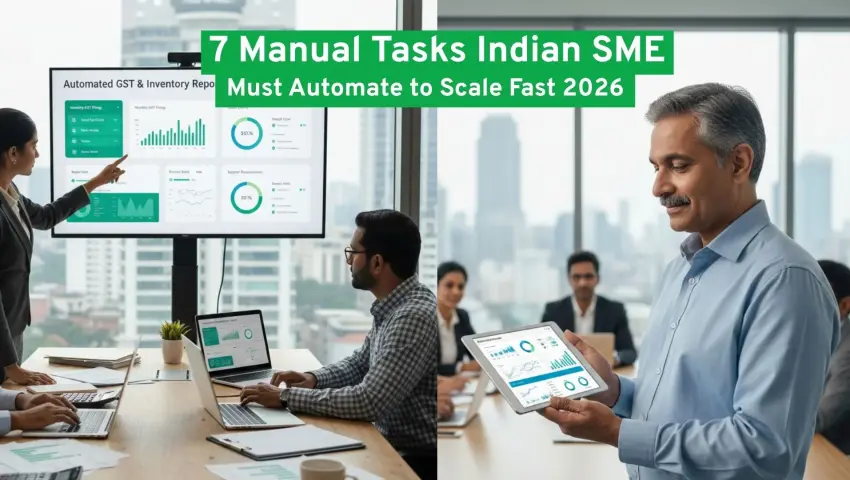
The 2026 Business Automation Checklist: 7 Manual Tasks Indian SMEs Must Automate to Scale Fast
 By Pragyantra
- Business Automation & AI
- Jan 12, 2026
- 4 minutes read
- 181 Views
7 Manual Tasks Indian SMEs Must Automate to Scale Fast
1. Problem-Led Introduction: Why Manual Work Is Holding SMEs Back
Across India, SMEs are growing faster than ever. Orders increase, teams expand, and compliance becomes more complex. Yet, many businesses still rely on manual processes built for a much smaller scale.
Common problems include:
- Sales data in CRM, but billing in Tally
- Inventory tracked in spreadsheets
- GST reports prepared at month-end manually
- Customer follow-ups dependent on individuals
- Management decisions based on delayed reports
This scattered setup creates double entry, reporting delays, and operational stress. As businesses move into 2026, scaling with manual workflows becomes risky.
This business automation checklist for SMEs highlights the seven tasks that most Indian businesses should automate to grow sustainably.
2. What Business Automation Really Means for Indian SMEs

Business automation is not about replacing people.
It is about reducing repetitive work and improving data flow between systems.
For Indian SMEs, automation usually means:
- Connecting accounting, CRM, inventory, and operations
- Using APIs instead of exports and uploads
- Creating live dashboards instead of manual MIS
- Ensuring GST and compliance data stays aligned
Automation becomes the foundation of digital transformation for Indian SMEs, especially when teams and transaction volumes increase.
3. How Automation Works (Simple Explanation)
Most automation follows a simple pattern:
- Data is captured once
- Systems sync automatically through APIs
- Reports update in real time
- Alerts highlight exceptions
- Teams act faster with accurate information
The goal is not complexity.
The goal is clarity.
4. The 2026 Business Automation Checklist (7 Critical Tasks)

1. Sales-to-Invoice Automation
Many SMEs still convert confirmed orders into invoices manually.
Why automate:
- Reduces billing delays
- Avoids pricing and GST errors
- Improves cash flow tracking
How:
CRM integrates with Tally so confirmed deals generate invoice drafts automatically.
2. GST Reporting & Compliance Automation
Manual GST reconciliation is time-consuming and error-prone.
Why automate:
- Fewer mismatches
- Cleaner audit trails
- Reduced month-end pressure
How:
GST automation tools pull data directly from accounting and sales systems.
3. Inventory Management & Stock Alerts
Stock-outs and overstocking hurt margins.
Why automate:
- Live stock visibility
- Auto-reorder alerts
- Better production planning
How:
Automated inventory management solutions sync sales, purchases, and stock levels.
4. Customer Journey & CRM Automation
Follow-ups often depend on memory or spreadsheets.
Why automate:
- No missed leads
- Better customer experience
- Consistent communication
How:
Customer journey automation CRM tools manage follow-ups, reminders, and updates.
5. Bank Reconciliation & Payment Tracking
Manual reconciliation slows financial closing.
Why automate:
- Faster month-end close
- Better cash visibility
- Reduced accounting errors
How:
API-based process automation connects banking data directly with accounting systems.
6. Management Reporting & MIS
Many owners wait weeks for reports.
Why automate:
- Faster decisions
- Clear business visibility
- Less dependency on teams
How:
AI-powered dashboards generate real-time MIS, P&L, and sales analytics automatically.
7. Approval Workflows & Internal Controls
Manual approvals delay operations.
Why automate:
- Faster decision cycles
- Better accountability
- Reduced operational friction
How:
Workflow automation tools for small business manage approvals digitally.
5. Real-World Indian SME Scenario
A mid-sized trading company uses Tally for accounting, a CRM for sales, and spreadsheets for inventory.
Before automation:
- Orders were billed manually
- Stock mismatches were frequent
- GST reports took days to reconcile
After applying this automation checklist:
- Sales flowed directly into billing
- Inventory alerts reduced stock issues
- Management reviewed live dashboards daily
Growth became more controlled and predictable.
6. Realistic Benefits of Business Automation
- Reduced operational costs through automation
- Faster order-to-cash cycle
- Improved compliance accuracy
- Better team productivity
- Stronger management visibility
Automation does not eliminate challenges, but it makes them easier to manage.
7. Who This Checklist Is For (And When to Wait)

Ideal for:
Growing SMEs, multi-branch businesses, manufacturing units, trading firms, and service companies.
Consider waiting if:
- Business volume is very low
- Systems are not yet standardized
- Processes are still evolving rapidly
Automation works best when workflows are reasonably defined.
8. FAQs
- Is automation expensive for SMEs?
Not always. Many automations start small and scale over time. - Do I need custom software development?
Sometimes. Custom automation software development helps when off-the-shelf tools do not fit workflows. - Will automation replace staff?
No. It reduces repetitive work and improves decision-making. - How long does automation take?
Implementation depends on complexity and integration needs.
9. How Pragyantra Helps
Pragyantra helps SMEs build a scalable tech stack for growing companies by connecting accounting, CRM, inventory, GST, and operations into one AI-powered dashboard.
Our approach focuses on:
- API-based integrations
- Practical automation
- Clear business visibility
Explore related services:
CRM–ERP API Integrations
Payment Gateway Integration Services
Explore related blog article:
Tally Prime on Mobile: How to View Your Tally Data Live
10. Soft, Honest CTA
If you are planning to scale in 2026,
learn more about our solutions and explore how automation can support your growth.

Pragyantra
Leave a comment
Your email address will not be published. Required fields are marked *